
Loading cart contents...
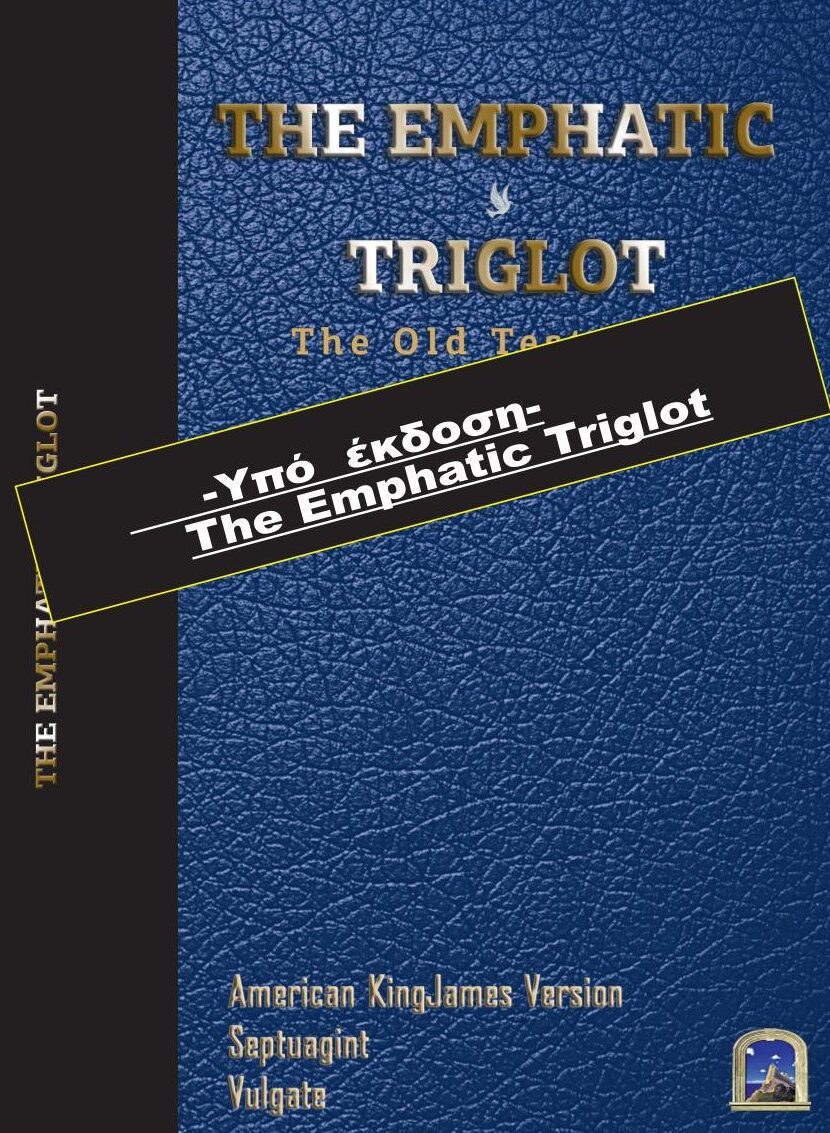
The Emphatic Triglot
The Emphatic Triglot is a unique edition of the Holy Bible that enables an English-speaking student of the Word to have a multi-dimensional view of the meanings originally ascribed by the sacred authors of the Old Testament, as well as to read the Greek New Testament in English.
The Old Testament was almost entirely written in Hebrew and only using consonants, as was the case with all ancient languages of that era, which resulted in the reader having to use their memory and experience in inserting the proper vowels. In 250 BC, the vowelless Old Testament was translated into Greek, which is the Septuagint, used by the Apostles and the Early Church. In AD 350, the vowelless Old Testament was translated into Latin by Jerome and this work was called the Vulgate. Between 700-1000, Hebrew scholars, known as Masorites, inserted vowels in the then-vowelless Hebrew O. T. and this text was used to translate the OT into English in the KJV. Now for the first time the reader can see the comparative differences and similarities among the three texts that are derived from the now lost vowelless Old Testament, in order to understand the meanings and/or assumptions made in all three texts.
The New Testament was written in its entirety in Greek, in the common language known as Alexandrian Koine. All the translations of the New Testament into all the different languages are derived from the Greek text. The King James Version is considered the best version of the NT in English. According to Webster’s Dictionary, of the 150,000 words in the English language, almost 1/3 is derived from Greek. English speakers say “God”, but the scientific study of God is called Theology, not Godology. Unfortunately, past translators have not complemented the English text with the thousands of words that are used and are derived from Greek. For the first time ever, the Emphatic Triglot demonstrates that English speakers actually speak Greek; they just don’t know it yet. Thus in the Scholar’s Edition of the Emphatic Triglot, one can read the Greek text transliterated into Latin characters beside the AKJV that has the Greek words that are used in English directly above them. Our Reader’s Edition includes the AKJV using all the English words that are of Greek origin or have the same meaning in both languages, with the corresponding English word above it.